Hello fellow collectors, It is maybe interesting to compare this two sets, with the same content, correponding to catalogue No.1, but somehow different.
The one with L&NWR livery is probably the very first one from late 1922, while the MR livery is a later version, just before the change to the yellow boxes? The more interesting differences is the way the train is boxed, in individual partitions on one case and with a card insert in the second case, that was later used in every set. Also the colour of the tracks is quite different, with the green sides much lighter for the earlier version. I hope this is of some interest. Regards, Manuel
a very interesting comparison. Thanks for showing these two sets since it is not so easy to find complete and original sets (including the tracks!) these days.
Do the tracks with the ligth green sides have a special colour on the backside? I have also some light(er) green tracks and the backside is painted in light blue, a colour that I could not find on any other tracks.
I think 1924 is a reasonable date for the appearance of the big four (for Bing it was only the big three: LMS, LNER and GWR) and the disappearance of MR and LNWR. 1924 was also the year of introduction of the electric versions and best to my knowledge no electric Midland and LNWR is known. There is an electric American tank loco in Carpenter's book showing the LNWR livery, but with overpainted LNWR letters.
not sure about Midland, but the remaining stock of LNWR chassis was overpainted to either make Continental or American Locos, so it looks like a hard break!
I would love to have a SR livery on one of my locos, however I need to check my inventory on hopeless tank locos...
Hello again, The back of the tracks is grey, some lighter some darker, not all the same, and also some with stamped "made in germany": In the bad pictures tis stamp just looks like dirt! About the details of the new liveries, Patrick said it all, I can add nothing. Interesting that Trix never made GWR, also just 3 companies... I never connected this with Bing TT! One more comment is that the tracks still have very simple straight connecting pins, that later would have a bend across the rail to prevent it to slip when mounting (or unmounting) the tracks. Regards, Manuel PS: I think I have also soem track with light blue back (somewere...), but not of the light green sides.
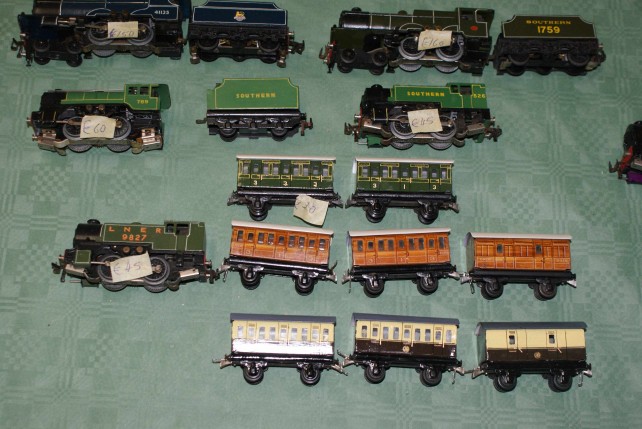
The Southern locos in the centre of the picture wear the postwar malachite green livery, but the short suburban coaches have the prewar dark green livery.
Yes, John Hopkinson can make wonderfull repaints, creating quite nice neverwazas! I never met him personaly, but I have some repaints on TTR items made via Franz Nowack. He also was one of the first serious collectors of this tinplate TT trains, it seems he just has some remaining items now, and I go some from him (on Ebay) in the past. Manuel
Hello, you all! You are quite right: the LIGHT green track belongs to the very first package, probably even to those which came out BEFORE the catalogues. It took me quite a while to find out about - unless I found an early package myself. A year ago - or so - I tried to find out a system of the different colors of track according to which we can date the making. I remember discussing it with another collector.... But in the end we could not really make it. There are only rought hints:
CLOCKWORK 1. The light green track belongs to package no. 1, maybe even earlier. 2. Track with brown layers WITHOUT clamps is very early and came with the black boxes. 3. Track with brown layers AND clamps came later but still with the black boxes. 4. Track with black layers WITHOUT clamps belongs to the early yellow boxes. 5. Track with black layers AND clamps came with the later yellow boxes. 6. Track with holes for clamps but those MISSING (not lost but never put in!) came quite late, when metal wasn't availabel - due to shortage of material or money.
ELECTRIC There are numerous varieties in colors - either on top or on the backside of track. Up to now I couldn't find out any system.
Well - this is just a hypothesis. Whoever can add or correct something is very welcome!!!
just wanted to add another early No 1 set. It is an American Set including the loco with cowcatcher and the obeservation car.
Interestingly it seems to be from the same series as the uncatalogued set I showed recently, because it has the same logic of numbering - '11/920' and '15': Uncatlogued Set 11/921
Manuel, does your early set also have a numbering on the back?
Nice catch Patrick that set (and also the other)! My very early set 1 is numbered like this: I think it reads 61/3309 (or maybe 3300?) and 15. Jeff Carpenter mentions 11/920 in his book, I think. The A type loco in my set has teh "Bavaria" logo on the bunker. There is also a difference in the black paper, yours has a very strong pattern, unlike mine. Regards, Manuel
Many years ago I picked up an empty box without any inners. I made it up using Bing pieces and making inner sections of mountboard. On the base it is clearly marked 61/3300, and with the 15.
In pencil is the price of 6/6. That works out in current prices of thirty two and a half p. or 0.41 euros.
I don't think we'll find any at that price any more.
Regards,
Geoff.
sg067340 †
hat folgende Bilder an diesen Beitrag angehängt
here's another No 1 Set that is probably unusual - I got it from the latest Lankes auction. Unfortunately, I could not identify the numbering
In the beginning I thought the original Midland loco has been exchanged with the continental loco included in that set.
However Jeff Carpenter describes these compilations sold as Continental sets in his book on page 54 and 55. He mentions the coaches not fiitted with buffers and having the brighter crimson red colour.
The only difference is the grey roof - according to Jeff the roofs should be brown to match the other European stock.
Hello dear friends, I got another early No. 1 Set, Midland Railway, in excellent condition. The number is again 61/3300, and a 15. Interesting to note that the tracks are of two kind, straights very early light green, and the curves later darker green. It must be original like this considering the most probably unused condition of the Set. Regards, Manuel
this is a wonderful set in great condition -congratulations!
I have no doubt on its originality. I also have early sets with light green and dark green tracks mixed. The catalogue number 61/3300 also proves that it is an 'uncatalogued' set from 1922 even so it already has the later inserts for the train.
Kollegin, Kollegen, mich wundert immer wieder, was da so an Bing-Tischbahnen auftaucht. Eigentlich richtige Mengen bei Ebay, Saalauktionen, Börsen usw. Gebaut wurden diese schönen Dinge ja nur zwischen 1922 und 1932 -ganze 10 Jahre! Es muss eine gute Nachfrage geherrscht haben -trotz aller Probleme dieser Zeit. Erstaunlich! Schönes Wochenende wünscht Botho
wenn man liest, wieviel Bing produziert hat und vor allem, wie voll die Lager nach 1932 waren, dann wundert mich das nicht. Gerade die Tischbahn mit dem geringeren Verbrauch an Material und den günstigeren Preisen (sowohl in der Herstellung als auch im Handel) könnte somit mengenmäßig noch in großen Stückzahlen "verramscht" worden sein? Klar, der WK2 forderte seinen Tribut auf Dachböden und in Kellern, aber längst nicht alle Städte (Kleinstädte meist sowieso nicht) wurden in Schutt und Asche gebombt.
1932 ist zwar richtig was die Herstellung bei Bing angeht, es muss aber soviel "auf Halde" produziert worden sein, dass selbst im 1938er Bonds Handbook, wenn auch etwas abgespeckt, immer noch Bing Tischbahn angeboten wurde.
Ja, Patrick, die heutige Vielfalt ist nur mit großen Lagerbeständen zu erklären -vermutlich voran in England. Die Produktion lag also wohl deutlich über dem Bedarf. Schönes Wochenende wünscht Botho